


Denon DJ PRIME 4 G2 Review: Is This the Best Standalone DJ System of 2026?
Denon PRIME 4 G2 vs Pioneer XDJ-AZ vs PRIME 4+ — Complete Features, Stems, Jog Wheels, FX, Sound, DMX & Buying Guide
The battle for the best standalone DJ system just became much more interesting.
Denon DJ has introduced the PRIME 4 G2, and on paper this isn't simply another four-channel DJ controller.
It is a serious attempt to redefine what a modern all-in-one DJ system can do.
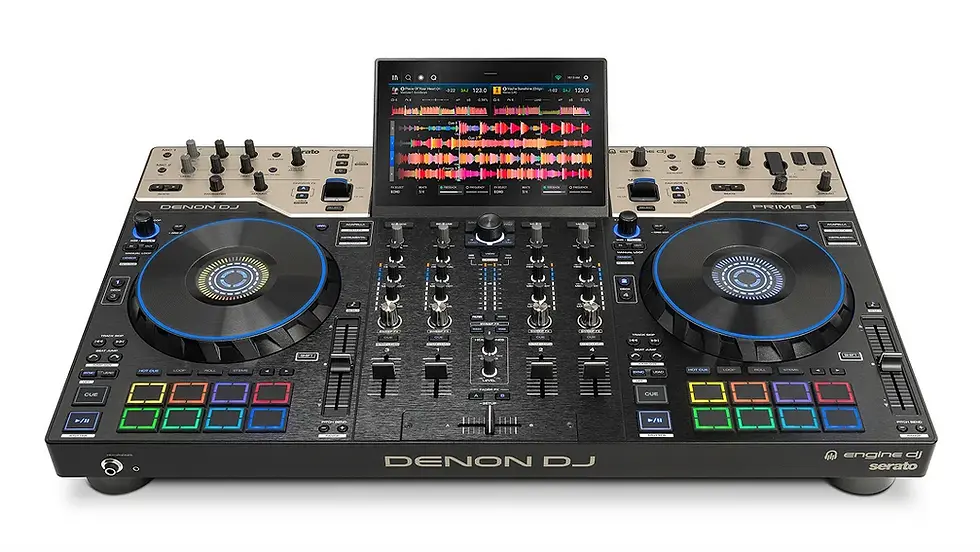
You've got four-deck standalone mixing, full-size 8-inch jog wheels, a 10.1-inch touchscreen, onboard Stems processing, 16 MPCe performance pads, advanced FX, integrated DMX lighting control, professional audio outputs, streaming, internal storage support and a dramatically more powerful processing architecture.
And then there's the obvious question:
Is the Denon DJ PRIME 4 G2 actually better than the Pioneer/AlphaTheta XDJ-AZ?
And perhaps an even more important question for existing Denon users:
Is it worth upgrading from the PRIME 4+?
That's what we're going to find out.
At DJ Training Academy, we don't believe in simply reading a manufacturer's feature list and calling something "revolutionary."
Let's look at what these features actually mean when you're standing behind a DJ booth.
Denon DJ PRIME 4 G2 — At a Glance
The PRIME 4 G2 is a professional 4-channel, 4-deck standalone DJ system built around Denon's Engine DJ ecosystem.

The idea is simple:
Take the functionality of multiple pieces of DJ equipment and put it into one professional performance system.
You don't necessarily need:
A laptop
External media players
An external mixer
A separate lighting interface
A separate Stems computer
An external music streaming device
The PRIME 4 G2 can potentially handle all of these functions from a single unit.
That is what makes it so interesting.
And the new hardware goes considerably deeper than a cosmetic upgrade.
What's Actually New in the PRIME 4 G2?
Let's get straight to the important stuff. The biggest PRIME 4 G2 upgrades include:
1. Full-size 8-inch jog wheels
The G2 moves to larger 8-inch jog wheels designed to provide a more substantial, club-style platter experience.
2. 16 MPCe performance pads
The G2 introduces Denon's MPCe multi-zone performance pad technology, with velocity, pressure and 3D sensing.
3. More powerful processing
Denon has moved to an 8-core ARM processor and 4GB RAM, with the company claiming approximately four times the processing power of the previous generation.
4. Onboard Stems rendering
The G2 can perform Stems processing directly on the hardware.
5. New Stems workflow
Dedicated Acapella and Instrumental controls, Stems EQ and Stems FX provide considerably more hands-on control.
6. New FX architecture
The G2 introduces new FX paddles, Favorite FX, Fader FX and Touch FX functionality.
7. Integrated DMX
A built-in isolated 3-pin DMX output provides direct lighting control.
8. Redesigned navigation
Playlist Bank controls and updated navigation make library management faster.
9. USB-C
The PRIME 4 G2 adds a USB-C computer/media connection.
10. Bluetooth 5.4 and Wi-Fi 5
Modern wireless connectivity is built into the system.
And that's before we get into the existing PRIME platform features.
The 8-Inch Jog Wheels: A Bigger Deal Than It Sounds
Let's start with something DJs actually touch. The jog wheel.

The PRIME 4 G2 features 8-inch jog wheels, making them substantially larger than the compact platters found on many standalone systems.
For a beginner, this may sound like a simple specification. For an experienced DJ, it isn't.
Jogwheel size affects how naturally you can:
Cue a track
Nudge the beat
Perform pitch corrections
Scratch
Manipulate playback
Perform transitions
The G2 also uses dynamic RGB LED information around the jogwheel, giving you visual feedback during performance.
This is one area where Denon has clearly responded to DJs who want a more substantial physical interface.
The 10.1-Inch Touchscreen

At the centre of the PRIME 4 G2 is a 10.1-inch HD multi-touch display with 1280 × 800 resolution.
This isn't just a track browser.
It becomes another performance interface. You can use the screen for:
Track browsing
Search
Waveforms
Library management
Track information
FX
System configuration
Streaming
Lighting
Performance controls
The advantage of a touchscreen is obvious.
Instead of relying entirely on physical buttons, the interface can adapt depending on what you're doing.
But here's something important:
A good DJ system shouldn't force you to use the touchscreen for everything.
And this is where the PRIME 4 G2 becomes interesting.
Denon has continued to provide a large number of dedicated physical controls.
The touchscreen handles information and advanced interaction.
The knobs, faders, paddles and pads handle performance. That's the right philosophy.
MPCe Pads: Denon's Most Interesting Hardware Upgrade?

The PRIME 4 G2 features 16 MPCe performance pads.
These are not ordinary RGB performance pads.
Denon's MPCe technology introduces multi-zone interaction with velocity, pressure and 3D sensing.
This means a pad can potentially perform multiple functions depending on how you interact with it.
You can use the pads for functions including:
Hot Cues
Stems
Rolls
FX
Lighting
Performance controls
This is particularly interesting for DJs who want to perform rather than simply mix.
Think of the pads as another instrument.
Instead of:
Track → Mix → Track → Mix
you can start moving toward:
Track → isolate → manipulate → layer → trigger → remix → transition
That is a fundamentally different approach to DJ performance.
Stems: Is the PRIME 4 G2 a Live Remixing Machine?
This is probably the feature most people will immediately want to test.
Stems.

Stems technology allows DJs to separate elements of a track, such as:
Vocals
Drums
Bass
Instrumental elements
The PRIME 4 G2 takes this further by supporting onboard Stems rendering.
This is important because modern DJ Stems processing requires significant computational power.
And that explains why Denon's processor upgrade matters.
You can now use Stems as part of the standalone workflow rather than treating it purely as a computer-based feature.
Wait — Doesn't PRIME 4+ Already Have Stems?
Yes. And this is an important distinction. Engine DJ introduced Stems support for PRIME 4+ in 2024. So if you're a PRIME 4+ owner thinking:
"I'm upgrading just because the G2 has Stems."
That's not a strong enough reason. The upgrade case is much broader.
The G2 combines Stems with:
New hardware processing
MPCe pads
Dedicated Stems controls
8-inch jog wheels
New FX architecture
DMX
New navigation
Expanded connectivity
That's where the G2 becomes a different proposition.
The PRIME 4 G2 Processor
Underneath the controller is arguably one of its most important upgrades. The G2 features:
8-core ARM processor
4GB RAM
Denon claims approximately four times the processing power of the previous generation.
Why is that important?
Because today's standalone DJ system isn't just playing music.
It is simultaneously managing:
Audio + Waveforms + Stems + Effects + Touchscreen + Library + Streaming + Lighting + Performance Pads
The processor is effectively the engine behind the entire system. And this is one of those specifications that won't necessarily impress you when you first look at the controller.
You'll notice it when the system is doing complicated things at the same time.
PRIME 4 G2 Sound Card & Audio Quality
This is where DJs should pay attention.
The PRIME 4 G2 uses an:
ESS ES9017S 32-bit DAC
The balanced main outputs are specified at up to:
119 dB A-weighted dynamic range
with up to:
+20 dBu maximum output level
and:
0.001% THD+N
Frequency response is specified at:
20 Hz – 20 kHz
These specifications are more than adequate for professional DJ applications. And that's important because a DJ controller isn't just a MIDI interface.
It's the actual front end of your sound system. If you're connecting it to a professional club PA, wedding sound system or festival system, output quality matters.
PRIME 4 G2 FX: Denon Went Big
his is another area where the G2 becomes considerably more performance-oriented.
You get 26 Main FX.
Then you have separate systems for:
Sweep FX
Filter
Noise
Wash
Reverb
Fader FX
Fader Echo
Echo Down
Stutter Verb
Reverb Down
Touch FX
10 touchscreen-based effects including:
LFO Echo
Filter Roll
Filter Echo
Filter Dub Echo
Filter Gate
Noise Gate
Filter Reverb
Flanger
LFO Filter
Filter
This gives the DJ several different ways of interacting with effects. You aren't just turning an FX knob.
You can use:
Knobs + Faders + Touchscreen + Paddles + Pads to manipulate effects.
That's a serious performance-oriented approach.
FX Paddles: Small Feature, Big Workflow Difference
The FX paddles are particularly interesting. Why?. Because they make effects more immediate.
Instead of:
Select effect
Adjust parameter
Turn effect on
Turn effect off
You can use a physical performance gesture. For DJs performing live, physical immediacy is important.
You want the effect to happen when you want it—not after you've navigated through a menu.
Integrated DMX Lighting Control
This is where the PRIME 4 G2 starts separating itself from conventional DJ controllers.
It has a built-in: 3-pin DMX output supporting: 1 DMX universe / 512 channels
This means lighting control is built into the system. And it integrates with the Engine Lighting ecosystem and SoundSwitch.
For a mobile DJ, wedding DJ or event DJ, this could be huge. Because now you can potentially control: Music + DJ Performance + Lighting from the same system.
You can even use the MPCe performance pads for lighting control. This is not just another DJ feature.
It's an attempt to turn the PRIME 4 G2 into an event-performance command centre.
PRIME 4 G2 Connectivity
This is another area where the G2 is built for professional applications.

Storage
You can use:
USB drives
SD cards
Internal SATA storage
Computer
USB-C connectivity is available.
Wireless
Wi-Fi 5
Bluetooth 5.4
Audio
Balanced XLR Master
RCA Master
Balanced XLR Booth
Balanced XLR Zone
Microphones
Two XLR/1/4-inch combo inputs.
Headphones
1/4-inch
3.5 mm
Lighting
3-pin DMX
That's an enormous amount of connectivity for a single DJ system.
PRIME 4 G2 vs Pioneer XDJ-AZ vs PRIME 4+
Now we get to the question almost every serious DJ will ask
Which one should you buy?
Let's compare them.
Feature | Denon PRIME 4 G2 | AlphaTheta XDJ-AZ | Denon PRIME 4+ |
Type | Standalone 4-deck | Standalone 4-deck | Standalone 4-deck |
Touchscreen | 10.1" | 10.1" | 10.1" |
Jog Wheels | 8" | 206 mm | Smaller PRIME design |
Performance Pads | 16 MPCe | 16 | 8/standard layout |
Stems | Yes | Software-dependent workflow | Yes |
Onboard Stems Rendering | Yes | Not the same Engine approach | No |
DMX | Built-in | External ecosystem/workflow | No built-in DMX |
Engine DJ | Yes | No | Yes |
rekordbox | Future/hybrid possibilities | Native ecosystem | No |
Serato | Planned OmniSource support | Supported | Controller/software mode |
Main FX | 26 | Pioneer/AlphaTheta FX ecosystem | 25+ |
Fader FX | Yes | No equivalent system | No |
Touch FX | Yes | No equivalent | No |
Internal SATA | Yes | No | Yes |
Wi-Fi | Yes | Yes | Yes |
Bluetooth | 5.4 | Yes | Yes |
Zone Output | Yes | Yes | Yes |
Dual Mic | Yes | Yes | Yes |
Standalone without laptop | Yes | Yes | Yes |
Best ecosystem | Engine DJ | rekordbox/AlphaTheta | Engine DJ |
Approx. weight | 9.9 kg | 13.5 kg | ~9.7 kg |
Event DJ features | Exceptional | Very good | Excellent |
Club familiarity | Very good | Excellent | Very good |
Creative performance | Exceptional | Excellent | Excellent |
The XDJ-AZ is physically larger and heavier, measuring 895 × 504.1 × 133.4 mm and weighing 13.5 kg. It also has a 10.1-inch touchscreen and a workflow designed around AlphaTheta's ecosystem.
PRIME 4 G2 vs XDJ-AZ: Which Is Better?
This isn't a simple "A is better than B" situation. They're designed around different philosophies.
Choose PRIME 4 G2 if you want:
Maximum standalone flexibility
Stems performance
MPCe performance pads
Integrated DMX
Advanced FX
Fader FX
Touch FX
Internal storage
Event/wedding features
Zone-based audio
Streaming flexibility
A more experimental performance workflow
Choose XDJ-AZ if you want:
AlphaTheta/Pioneer-style club workflow
rekordbox integration
Familiarity with professional Pioneer/AlphaTheta booth equipment
Club-standard layout
CDJ-style performance philosophy
Easy transition between your all-in-one system and club equipment
The XDJ-AZ is particularly compelling if your ultimate goal is "I want my home system to feel as close as possible to the equipment I will encounter in professional DJ booths."
That's its biggest strength.
PRIME 4 G2 vs PRIME 4+: Should You Upgrade?
This is the more difficult question. Because the PRIME 4+ is already a very capable machine.
It already offers:
Four-deck standalone operation
10.1-inch touchscreen
Engine DJ
Streaming
Internal drive support
Stems
Professional outputs
Four-channel mixing
Advanced FX
So why buy the G2?
The strongest reasons are:
8-inch jog wheels
MPCe pads
Onboard Stems rendering
New FX architecture
Fader FX
Touch FX
Integrated DMX
More processing power
New navigation workflow
USB-C
If you already own a PRIME 4+, the G2 is therefore more of a performance upgrade than a basic functionality upgrade.
If you're buying your first high-end standalone system, the decision is easier.
Which Is Best for Wedding DJs?
PRIME 4 G2 wins. And here's why.
Wedding DJs aren't just DJs. You're often dealing with:
Music requests
Microphones
Announcements
Different rooms
Dinner music
Dancefloor music
Lighting
Last-minute requests
Streaming
Huge libraries
The PRIME 4 G2 is almost tailor-made for that environment.
The Zone output, microphone inputs, streaming, internal storage and DMX integration make it particularly attractive.
Which Is Best for Club DJs?
XDJ-AZ has the advantage.
Not necessarily because it has more features. Because of ecosystem familiarity. If the clubs you play in predominantly use AlphaTheta/Pioneer DJ equipment, learning on an XDJ-AZ can make the transition to professional booths more natural. That matters.
A DJ system isn't just about specifications. Workflow matters.
Which Is Best for Creative DJs?
PRIME 4 G2.
This is where Denon is strongest. Stems + MPCe + FX + touchscreen + four decks + DMX create an enormous creative playground. If you want to perform rather than simply mix, the G2 is extremely attractive.
Which Is Best for Beginners?
Honestly? None of these is necessary for a beginner.
If you're learning basic DJing, a much smaller and cheaper controller makes more sense.
You don't need:
4 decks
DMX
onboard Stems
16 advanced pads
multiple FX engines
to learn beatmatching.
But if you're a beginner with serious long-term ambitions and budget isn't the issue, buying a professional system can give you room to grow.
Which Is Best for Mobile DJs?
PRIME 4 G2.
This is probably the strongest category for the Denon.
The combination of:
Four decks + microphones + Zone output + lighting + streaming + standalone operation
makes it an extremely powerful mobile DJ platform.
Is PRIME 4 G2 the Best All-in-One DJ System?
There is no universal "best." But if we judge purely on the amount of functionality packed into one standalone system, the PRIME 4 G2 is extremely difficult to ignore.
The interesting part is that Denon isn't competing purely on: "Who has the biggest jog wheel?"
It's competing on: "How much can the DJ do without needing anything else?"
And that's a much more interesting battle.
Our DJTA Verdict
After looking beyond the marketing terminology, here's our take.
For maximum creative control: PRIME 4 G2
For club-style workflow: XDJ-AZ
For value if you already own PRIME 4+: Keep your PRIME 4+ unless you specifically need the G2 upgrades.
For wedding/mobile DJs: PRIME 4 G2
For beginners: Buy something smaller.
For professional DJs wanting an all-in-one workstation: PRIME 4 G2 deserves serious consideration.
The Bottom Line
The PRIME 4 G2 isn't interesting because it has more buttons. It's interesting because Denon is changing the role of the standalone DJ system.
The traditional concept was: Music player + mixer + effects.
The PRIME 4 G2 moves toward: DJ system + performance instrument + Stems workstation + lighting controller + music library + streaming system + event control centre. And that is a much bigger proposition.
The XDJ-AZ remains the obvious choice for DJs who prioritize the AlphaTheta/rekordbox and club-style ecosystem.
The PRIME 4+ remains an extremely capable machine and shouldn't suddenly be considered obsolete.
But if you want the newest Denon standalone platform and intend to exploit its creative performance capabilities, the PRIME 4 G2 is arguably the most complete Denon all-in-one DJ system yet.
And that is why this isn't simply another controller launch. It's a statement about where standalone DJing is heading.
Frequently Asked Questions
Is the Denon DJ PRIME 4 G2 standalone?
Yes. It is designed as a four-deck standalone DJ system and can be used without a laptop.
Does PRIME 4 G2 have Stems?
Yes. The PRIME 4 G2 supports Stems and onboard Stems rendering.
Does PRIME 4+ have Stems?
Yes. PRIME 4+ received Engine DJ Stems support in 2024.
Does PRIME 4 G2 have 8-inch jog wheels?
Yes. The G2 features full-size 8-inch jog wheels.
How many pads does PRIME 4 G2 have?
There are 16 MPCe performance pads.
Does PRIME 4 G2 have DMX?
Yes. It includes an integrated 3-pin DMX output supporting one DMX universe.
Does PRIME 4 G2 have a touchscreen?
Yes. It has a 10.1-inch HD multi-touch display.
Does PRIME 4 G2 have an internal SSD?
It has an internal SATA 3.0 drive bay/interface for optional internal storage.
Can PRIME 4 G2 stream music?
Yes. Supported streaming services include Apple Music, Amazon Music Unlimited, Beatport, SoundCloud Go+ and TIDAL, subject to service availability and account requirements.
Is PRIME 4 G2 better than XDJ-AZ?
Not universally. PRIME 4 G2 is stronger for standalone flexibility, creative performance, Stems, MPCe and integrated lighting. XDJ-AZ is stronger for AlphaTheta/rekordbox and club-style workflow.
Is PRIME 4 G2 better than PRIME 4+?
It is more advanced, but PRIME 4+ owners should upgrade only if they specifically want the G2's new hardware, processing, MPCe, 8-inch jog wheels, DMX and expanded performance features.
Is PRIME 4 G2 good for wedding DJs?
Yes. Its four decks, microphone inputs, Zone output, streaming, lighting integration and standalone workflow make it particularly suitable for wedding and mobile DJs.
Is PRIME 4 G2 good for beginners?
It can be, but it is probably excessive for someone learning basic DJing. A smaller controller is usually a more sensible first purchase.
Is PRIME 4 G2 good for professional DJs?
Yes. It is designed as a professional standalone DJ system with four-deck control, professional outputs, advanced processing, effects, Stems and extensive connectivity.
DJTA's Final Score
Hardware: 9.5/10
Standalone capability: 10/10
Creative performance: 10/10
Effects: 9.5/10
Stems: 9.5/10
Connectivity: 10/10
Event/Wedding DJ functionality: 10/10
Club workflow: 8.5/10
Portability: 8.5/10
Overall: 9.5/10
DJTA Verdict: One of the most feature-packed standalone DJ systems to watch in 2026.
Ready to Master DJing, Music Production & Sound Design? This Is Exactly What We Teach.
At DJ Training Academy (DJTA), we don't just teach you how to DJ—we help you build the complete skill set required to become a professional electronic music artist.
Whether you’re starting from scratch, want to become a better DJ, or want to learn how to create your own music, our courses are designed around real-world industry workflows, professional techniques, and hands-on training.
Choose the path that matches your goals:
🎧 DJ Courses — Learn professional DJing, from fundamentals to advanced club & festival techniques.
🎹 Ableton Essential Course — Master the essential tools and workflow of Ableton Live.
🎼 Electronic Music Production Course — Learn how to turn your musical ideas into professional electronic music.
🔊 Sound Designing Course — Learn synthesis, sound creation, processing and how to design your own signature sounds.
🚀 Advanced DJ & Music Production Training — Take your DJing and production skills to a professional level.
Whether you want to DJ professionally, produce your own tracks, develop your signature sound, or simply understand how modern electronic music is created, DJTA gives you the skills, workflow and practical knowledge to move forward.
🔥 Your Next Move Starts Here
Learn. Create. Perform. Become the Artist.
DJ Training Academy — Professional DJing, Music Production & Sound Design Training.
Thanks for reading
That’s all, folks! Thank you for reading, and remember, the key to becoming a great DJ or a music Producer, starts with the right foundation. Here at DJ Training Academy, we make sure to provide that right kick start to your DJ & Music Production journey.
If you found this review helpful, don't forget to like, share, and subscribe to our blog for more tips, tutorials, and reviews. We would love to hear from you. So do comment, and share your experience if you have used the product before.
Disclaimer:
The information shared in this blog has been carefully compiled from a range of credible and reputable online sources, along with insights from our experienced team of artist-bloggers who possess extensive hands-on knowledge in the fields of DJing and music production.
As a growing academy, we often face limitations in securing direct product endorsements, complimentary equipment, or licensed software for review and demonstration purposes. Due to the high costs associated with professional DJ and music production gear, we rely on such informational and reference-based content to ensure our students and readers stay informed about the latest tools, technologies, and advancements within the industry. We do not claim ownership of any videos or images sourced from third-party platforms or channels.
All information presented is used strictly for educational purposes only, with the aim of keeping our students and subscribers up to date on the newest DJ and music production equipment, software updates, features, and industry developments.
If any individual, company, or organization has concerns or objections regarding the use of any referenced material, we kindly request that you contact us at djta.delhi@gmail.com, and we will take immediate steps to address and resolve the matter.
Thank you for your understanding and continued support.
Why Choose DJ Training Academy New Delhi for DJ & Music Production Courses?
DJ Training Academy, New Delhi, is committed to helping DJs of all levels master industry-leading equipment. Our dedicated team offers a range of courses, including beginner & advanced course modules in Djing & Music Production specialized sessions focused on using cutting-edge industry standard education. Students gain access to hands-on training, real-time guidance, and tips to get the best out of the latest DJ controllers, mixers, and production tools.
Join Our Community
Looking for DJ Course?
or
Need Help for your first DJ Starter Kit?
If you need help setting up your first DJ Starter Kit or are looking to buy DJ equipment at the best possible price, look no further. We are here to help and provide you with the best prices and customize your DJ kit bundles according to your budget.


Comments